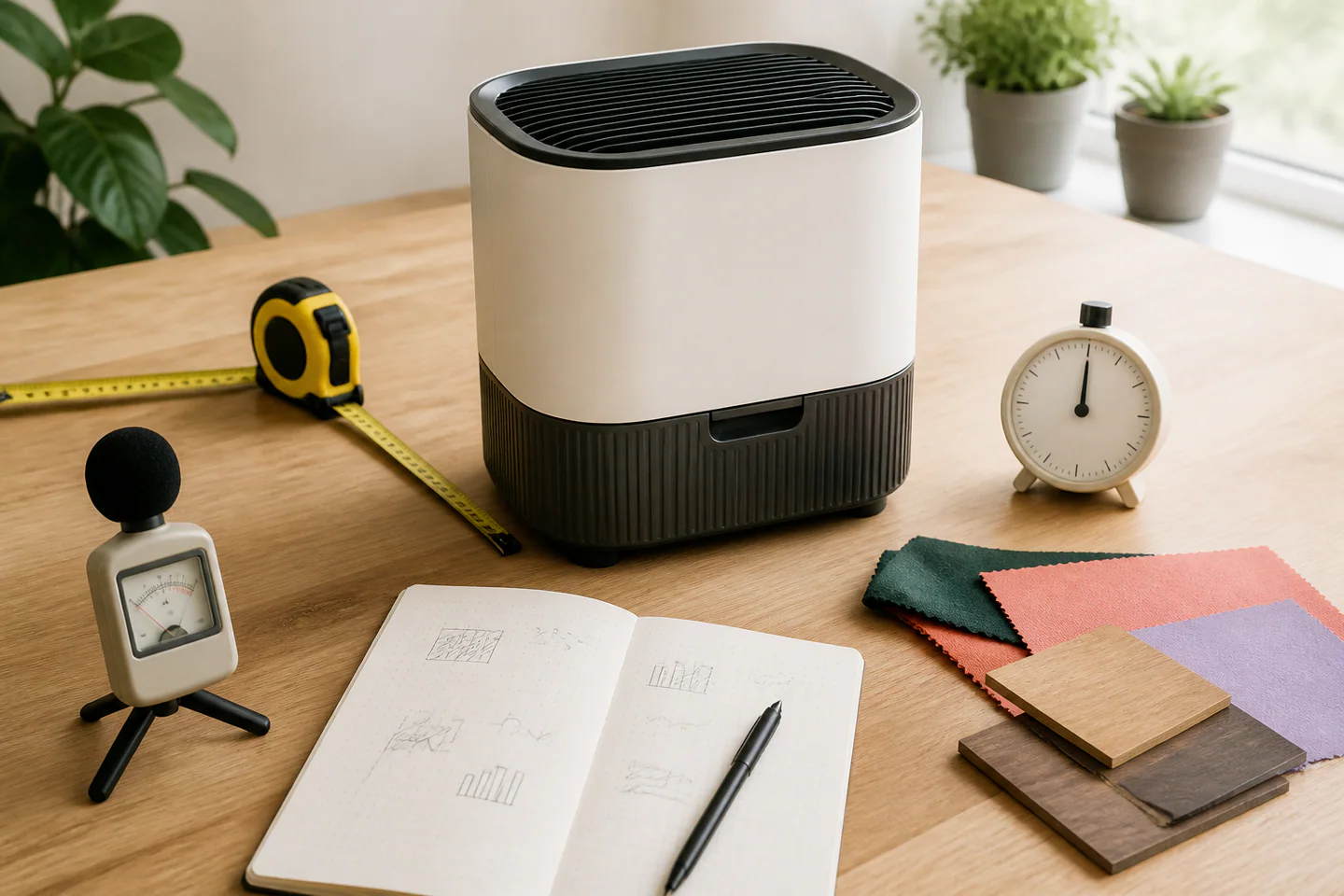
Product descriptions compress complex performance into words such as powerful, intelligent, durable or effortless. Those words are useful for attracting attention but too flexible for a decision. Verification means translating each promise into an observable question, identifying the conditions and finding evidence that matches the intended use. The goal is not to distrust every claim; it is to give each claim the confidence it deserves.
Turn adjectives into questions
For “fast”, ask which task is completed, from what starting point and in how much time. For “quiet”, ask at what distance, setting and background level. For “long-lasting”, identify the component, test cycle and maintenance assumptions. A claim becomes comparable only when its object, unit and conditions are visible.
Write the expected household scenario beside the question. Maximum performance may be irrelevant if it occurs only in a mode that is too noisy, consumes supplies quickly or lasts a few minutes. Normal settings and repeated tasks usually predict satisfaction better than a demonstration designed to show the highest number.
Read the conditions around the headline
Look for footnotes, included accessories, compatible modes and environmental limits. Battery runtime can depend on power level and attachment; capacity may exclude a safety margin; a cleaning result may use a specific surface and quantity. The condition does not necessarily invalidate the claim, but it determines whether the result applies at home.
Check whether the compared reference is current and similar. “Twice as effective” says little without the baseline. A percentage improvement in a laboratory measurement may create a much smaller practical difference. Record the original wording and avoid converting it into a broader promise.
Use an evidence ladder
Give the highest confidence to reproducible measurements under relevant conditions, followed by detailed technical documentation and consistent observed use. A short demonstration can confirm handling or fit but rarely establishes durability. Repeated owner reports may reveal patterns, yet they need context because expectations, maintenance and versions vary.
Separate evidence of a feature from evidence of its value. A sensor may be present and work exactly as described while adding little benefit to the intended task. Similarly, a premium material may improve appearance without changing service life. Keep the requirement sheet visible so verification remains connected to the buyer’s outcome.
Check physical and software dependencies
Measure dimensions, clearances, cable length, connector type and accessory fit. For software features, confirm supported phones, accounts, permissions, offline behaviour and update policy. A product advertised as smart may require a remote service for functions that appear local. Compatibility should be verified at the function level rather than through a platform symbol alone.
Look for replacement parts and consumables using identifiable references. A durability promise is weaker when the blade, filter or battery most likely to wear cannot be obtained. Warranty length, exclusions and repair process provide useful context, though a warranty does not replace maintainable design.
Design a fair acceptance test
Before purchase, define the few checks that will determine whether the product stays. They may include fitting the storage space, completing the main task, cleaning within a reasonable sequence, maintaining connection or being comfortable for the intended user. Use the product according to instructions and keep packaging and evidence until the test is complete.
Do not create a destructive experiment or exceed safe use simply to challenge a claim. For characteristics that require long observation, rely on support information and appropriate documented evidence. The acceptance test should confirm immediate suitability, not pretend to simulate years in one afternoon.
Assign a confidence level
Label each important promise confirmed, plausible with conditions, uncertain or contradicted. Explain the evidence in one sentence. If an uncertain claim is essential, postpone the purchase or choose an option with clearer support. If it is only a preference, reduce its weight rather than rejecting an otherwise suitable product.
This method protects the comparison from slogans without demanding perfect information. It rewards products whose useful qualities can be explained, measured and maintained. Most importantly, it keeps the final choice grounded in real tasks instead of the loudest promise on the page.
Verify claims made to UK buyers
Use the specification and terms for the exact UK model. Record the conditions attached to performance figures, such as test mode, room size, surface, network service or accessory. Check whether measurements use a recognised unit and whether the evidence describes normal use rather than a laboratory maximum that the household cannot reproduce.
Keep a dated copy of important claims and compare them with the instruction manual, energy information, warranty and retailer description. Note contradictions instead of choosing the most favourable wording. A claim earns confidence when its meaning, conditions and local model are clear; a prominent slogan without those elements should receive little weight in the decision.