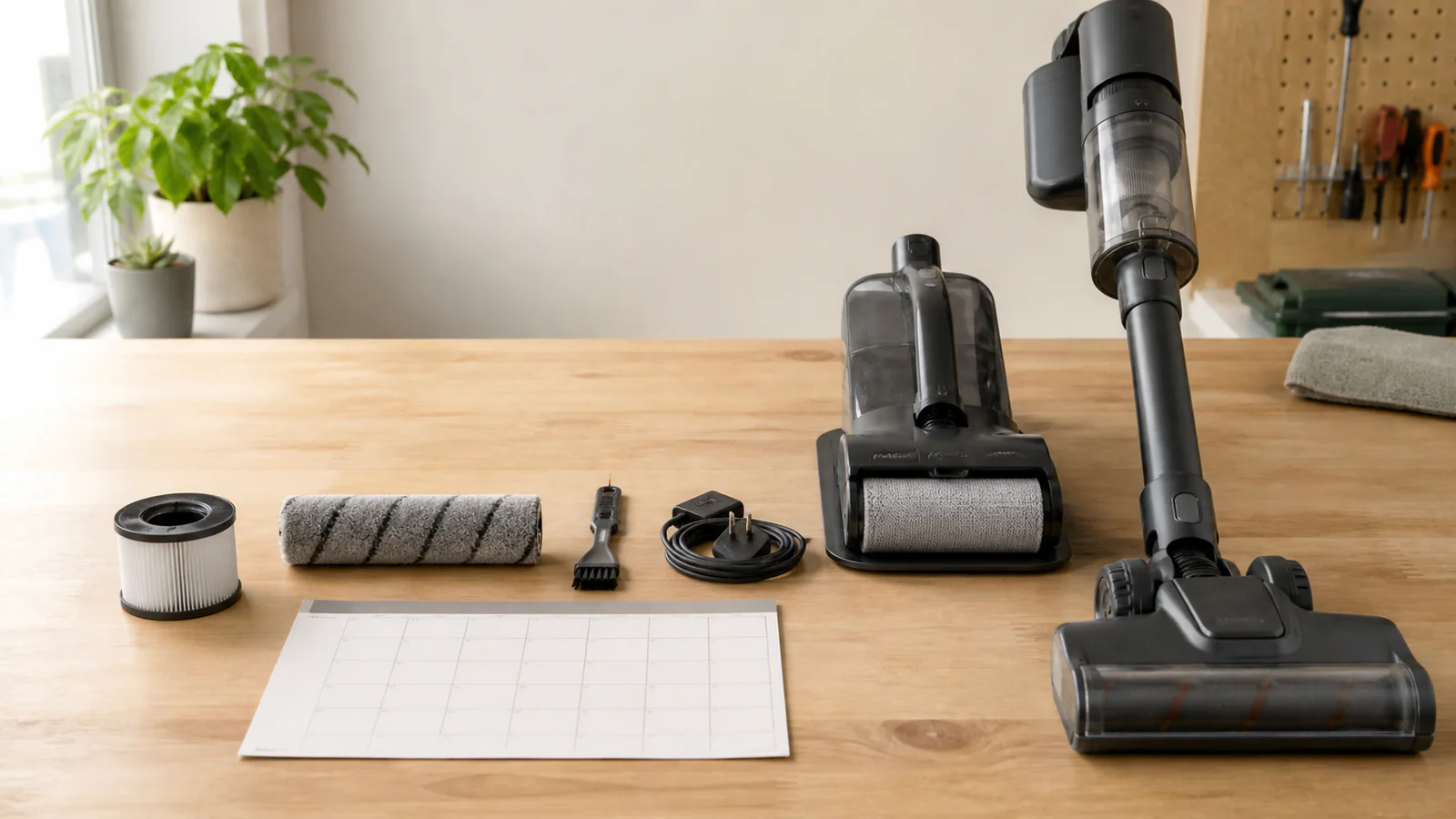
The displayed price of a home-care appliance is only one part of its cost. Filters, bags, brushes, batteries, compatible solutions, repairs and maintenance time can change the balance over several years. Comparing ownership cost does not require predicting an exact total. The useful task is to identify likely expenses, their frequency and the options for extending the appliance’s working life.
Separate acquisition, operation and end of life
Acquisition cost includes the machine and any accessories needed from the first day. An attractive entry price is less useful if a head suited to the main floor, a charging base or storage component must be added separately. A large accessory bundle is not necessarily valuable either when half of its contents address no real need.
Operating cost includes consumables and energy, along with wear parts such as rollers, seals, pads, mop cloths or side brushes, depending on the appliance. End-of-life considerations include a battery replacement, a significant repair, access to service and eventually the appropriate collection or recycling of the equipment.
Use a realistic comparison horizon
Choose one period for every product being considered. This does not claim that each machine will work for exactly that long; it simply places the scenarios on the same basis. Record the initial price, then add each recurring expense at a cautious frequency. When information is unavailable, write “unknown” rather than replacing it with an unjustifiably precise estimate.
Use at least two scenarios. A moderate scenario follows the expected maintenance routine and normal use. A demanding scenario reflects a larger home, frequent cleaning, animal hair or surfaces that place greater stress on brushes. Showing a range makes uncertainty visible and avoids the false confidence of a single total.
Investigate consumables before purchase
Record the reference for filters, bags or pads and check whether they are sold separately. A washable filter is not necessarily permanent: it can wear, lose shape or require replacement in accordance with the manufacturer’s directions. Washing also requires complete drying time. Keeping a second filter may be convenient, but it adds cost.
For a machine that uses a dedicated cleaning solution, verify whether an approved generic alternative is allowed. An unsuitable formula can damage a circuit, produce excessive foam or affect warranty protection. The safer calculation follows the instructions rather than assuming that a substitution will work.
Give repairability a practical value
The availability of useful parts is more valuable than a vague statement about durability. Look for the battery, charger, rollers, filters, wheels, tanks and small components exposed to regular handling. Determine whether replacement needs a common tool, an approved workshop or shipment of the complete appliance.
Read warranty terms for duration, covered components, proof of purchase, transport charges and service availability in the relevant region. A long warranty that is hard to use may offer less practical protection than an accessible repair network with clear procedures. Keep the receipt, serial number and a copy of the conditions that applied at the time of purchase.
Include the battery without pretending to predict it
In a cordless appliance, the battery is both a working component and a factor in product life. Check whether it is removable, whether its price is published and whether a replacement procedure is documented. A proprietary battery that is available now may become difficult to obtain later, so that uncertainty belongs in the comparison. Charging and storage practices from the instructions may slow degradation, but they do not remove natural wear.
Calculate with a simple worksheet
Create six lines for each option:
- the appliance and accessories that are genuinely required;
- expected consumables over the chosen period;
- wear parts and any likely battery provision;
- maintenance that can be completed at home;
- repair or transport in a cautious scenario;
- unknown items and availability risk.
Keep every assumption visible beside the total. If a bag is assumed to last two months, make clear that the interval depends on the home and usage. If a part has no known price, do not silently remove it from the model. Mark the risk and give appropriate credit to an option whose parts and procedures are documented.
Time and maintenance effort also matter
A machine with a bin, rollers and filters that are easy to clean is more likely to receive proper care. Regular maintenance protects performance and may prevent blockages from causing a failure. An unpleasant procedure is more likely to be postponed. There is no need to convert every minute into money; a simple rating of low, medium or high effort is enough to preserve the distinction.
Decide without demanding impossible precision
The calculation does not need to be perfect to be useful. It should reveal structural differences: dependence on costly consumables, an inaccessible battery, mandatory accessories, clearly available parts or maintenance that can be done at home. Compare those factors with cleaning quality and comfort for the household. The cheapest product to buy is not always the most economical, and the most expensive is not automatically the most durable. The stronger choice is the one whose performance, likely expenses and uncertainties remain acceptable together.
Build the UK ownership-cost line
Record all costs in pounds and compare VAT-inclusive prices. Add the normal local price of filters, bags, detergent, batteries and other wear parts at the replacement interval stated by the manufacturer. Electricity matters for frequently used appliances, but a transparent range based on expected use is more credible than a precise lifetime figure built on an unknown future tariff.
Check whether parts, repair information and service are genuinely accessible in the UK. Keep the receipt, model number and serial number, and distinguish a commercial warranty from any rights that may apply to the transaction. The comparison should not assign value to a long headline warranty unless the claim route, transport burden and exclusions are workable for the household.