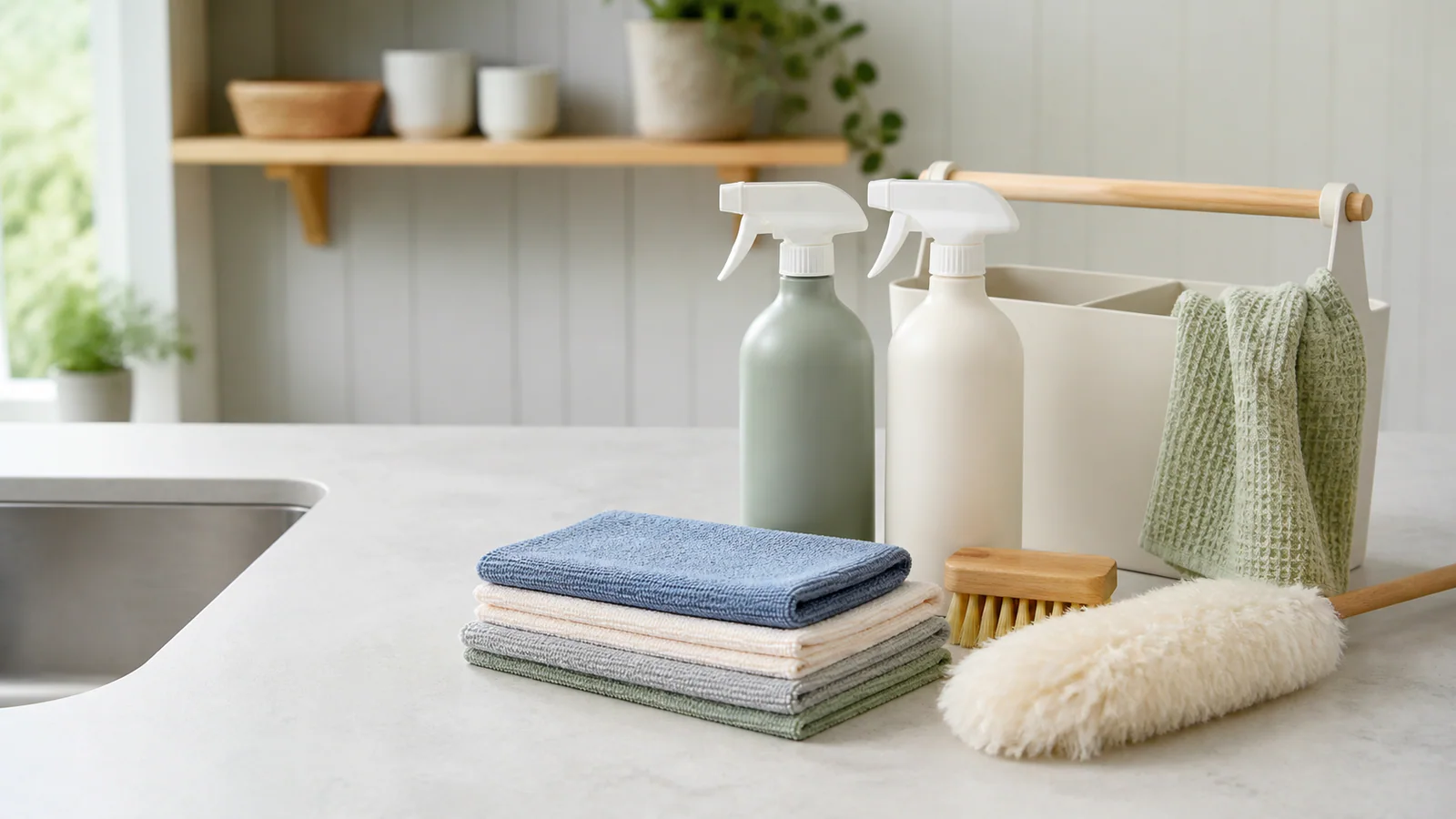
A home that is easy to maintain does not depend on a cupboard filled with highly specialised products. It depends more on methods that suit the materials, a few tools that are easy to find, and small tasks completed before dirt becomes difficult to remove. Reducing the size of the kit can improve consistency: every item has a clear purpose, storage is simpler and the chance of applying an unsuitable formula is lower.
Start with zones, not bottles
Divide the home into four groups: floors, frequently touched surfaces, damp areas and textiles. Floors collect dust and particles; handles, switches and worktops receive repeated contact; kitchens and bathrooms need particular attention to moisture; fabrics usually need vacuuming or a treatment compatible with their fibres. This map assigns a method to each need before anything new is purchased.
Then observe the real frequency. A light, regular pass in the entrance may avoid a heavy session throughout the home. Responding promptly to a spill, in accordance with the material’s care guidance, can limit a persistent mark. A routine does not need to treat every room with the same intensity on the same day.
Build a short, identifiable kit
A basic kit may include several washable cloths identified by colour or purpose, a soft brush, a dusting tool, a bucket or carrying caddy and only the products required by the surfaces in the home. Product labels and the care instructions supplied with a surface remain the reference for compatibility and dilution. A cleaner described as multi-purpose is not automatically appropriate for natural stone, oiled wood, screens, textiles or food-contact surfaces.
Prefer tools that rinse, dry and store easily. A damp cloth left in a closed caddy can develop an odour, while a brush that is difficult to wash soon becomes unpleasant to use. Storage should make missing supplies visible and keep household products safely separated from food, children and animals.
Avoid mixtures and protect indoor air
Never mix cleaning products, even when each formula works effectively on its own. Some combinations can release dangerous fumes or cause unpredictable reactions. Keep each product in its original container, follow its directions, ventilate the room and use the recommended protective equipment. If exposure or illness occurs, leave the area and contact the appropriate service in your country.
Quantity is not a measure of effectiveness. Using too much may leave a film, attract dust more quickly, make rinsing difficult or damage a finish. Measuring the dose and allowing only the stated contact time generally creates a more repeatable result.
Use a sequence that avoids repeated work
In a room, begin by moving the objects that block access. Dust from higher surfaces towards the floor so particles are collected by the final vacuum or mop. Treat each surface according to its material, then finish with the floor. Move to a clean cloth or an unused side as work progresses instead of distributing residue from one area to another.
In the kitchen, remove crumbs and dry residue first. Clean preparation areas in line with applicable hygiene needs and rinse whenever the instructions require it. In the bathroom, airflow and the regular drying of wet surfaces reduce moisture-related buildup. No universal schedule replaces observation: increase attention in busy zones and reduce it in seldom-used rooms.
Create three levels of routine
The immediate action
This takes less than two minutes: responding to a spill, returning a tool, ventilating a room or collecting particles in the entrance. Its purpose is to prevent a small task from becoming a much longer intervention.
The regular pass
This groups the most frequently used areas: vacuuming the main paths, wiping useful worktops, maintaining sanitary areas and replacing used cloths. It should remain short enough to repeat without disrupting the whole day.
The periodic check
This covers less visible places: appliance filters, spaces below furniture, skirting boards, seals, removable textiles and stocks of consumables. It is also the moment to inspect tools and replace worn items rather than waiting for a loss of performance.
Measure success with more than fragrance
A strong scent does not prove that a surface is clean. Look instead for the absence of sticky residue, visible dust, recurring marks and persistent dampness. Always try a new method on a small, inconspicuous area before expanding it. A note or photograph of a successful setup can preserve the right dilution and tool choices without repeated experiments.
A useful starting checklist
- A map of the home’s materials and sensitive areas.
- Washable cloths assigned to distinct purposes.
- A soft brush and dusting tool that are easy to clean.
- A limited set of compatible products, stored and dosed as directed.
- A ventilated drying place and safe storage.
- A short, realistic and repeatable sequence.
The best routine is not the one that claims to solve every task with a single motion. It is the one that protects materials, reduces unnecessary handling and can be followed consistently by the people who live in the home.
Adapt the routine to a UK household
Build the schedule around the home rather than an idealised checklist. Entrance areas may need more frequent attention during wet weather, while condensation-prone rooms benefit from a routine that includes safe ventilation and drying. A small flat may require fewer tools but better storage discipline; a multi-storey house may justify a lightweight duplicate cloth or brush upstairs instead of repeatedly carrying a full caddy.
Read the UK label for every cleaning product and follow its dilution, surface and ventilation instructions. Do not assume that two products with similar names have the same formulation. Price the routine using the normal shelf price and realistic refill frequency, then favour tools and concentrates that are easy to replace locally. The useful routine is the one that remains safe, affordable and repeatable through ordinary weeks.