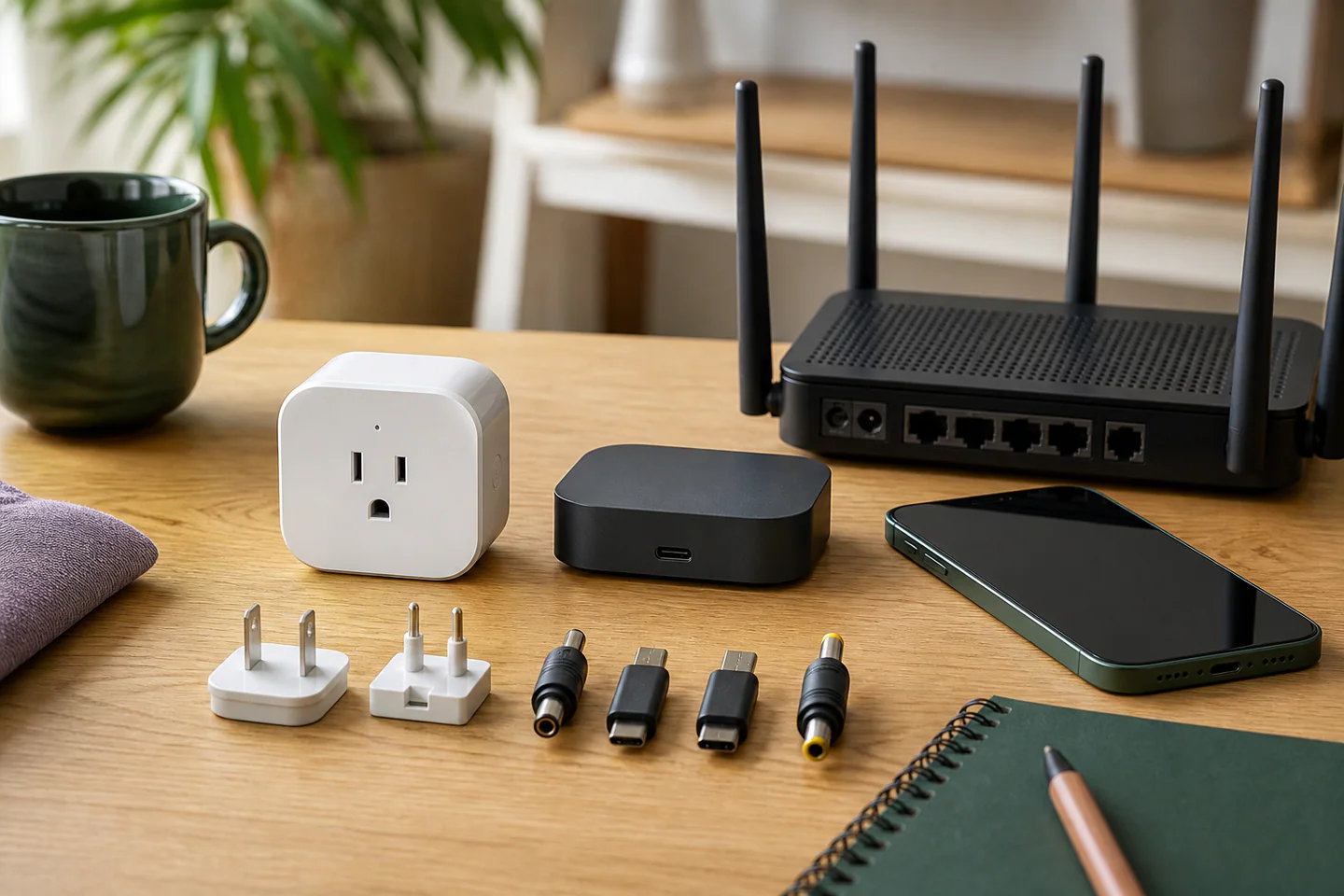
The word “compatible” is one of the least precise claims in the connected-device market. It may mean that a product appears in an application, responds to two voice commands or participates fully in household automations. Two products carrying similar symbols can therefore deliver very different experiences. A reliable compatibility check follows the complete journey: installation, daily use, an internet outage, a phone replacement, software updates and eventual removal.
Draw the current installation
Before opening a product comparison, list the equipment already present: phones, router, optional hub, voice system, lights, plugs, sensors and any device that must communicate with the new product. Record who administers each account and who only needs everyday controls. This small map exposes hidden dependencies and helps avoid adding another application for a marginal benefit.
Mark locations with weak network coverage. A sensor in a garage, a doorbell behind a thick wall and a lamp beside the router do not operate under the same conditions. A range figure measured in open space cannot predict every home. Installation distance, building materials, interference and hub placement can matter more than a headline specification.
Separate protocol, platform and available function
The protocol describes how devices communicate. The platform manages accounts, permissions and automations. The function is the action the user can actually perform. These three levels must be checked separately. A common protocol can simplify discovery without exposing every setting. Conversely, a cloud integration may offer many functions but stop working when internet access is lost.
Make a precise list of required actions: switch on, adjust brightness, change temperature, receive an alert, consult history or trigger a routine. Check whether status changes made by hand are reported correctly. For a lock, camera or heating system, examine sensitive functions in detail. Permissions, activity history, notifications and a dependable manual fallback should be clear before purchase.
Review installation and account sharing
A device that is easy for one person to install can be difficult for a household to share. Find out how an administrator invites another person, limits rights and removes access. Avoid systems that require everyone to use the main password. Household management should remain possible when a phone is replaced or a resident leaves.
Check the technical prerequisites: supported Wi-Fi band, Bluetooth during setup, QR code, maximum distance from a hub and application permissions. Some permissions are needed only during installation and should not remain broader than the use requires. Keep the recovery code and factory-reset instructions somewhere accessible. A clear reset procedure is essential if pairing fails or the product is sold.
Plan for degraded operation
Disconnecting the internet should not turn an essential function into an unusable object. A smart lamp should still respond to its switch, a thermostat should retain local control and a lock should have a reliable access method. Locally executed routines are often faster and more resilient, though they may require a hub. Cloud routines can be simpler to configure but create an extra dependency.
Also ask what happens after a power cut. Does the device restore its previous state, switch on automatically or wait for a command? The answer can be important for a bedroom lamp, heater or plug connected to sensitive equipment. Test or document this behaviour rather than assuming it follows the most convenient option.
Verify support over the intended lifetime
A connected product includes software, online services and security maintenance. Look for automatic or simple updates, an announced support period and a way to report vulnerabilities. A recently updated application is not a guarantee, but an abandoned application, inaccessible account process or obsolete documentation is a reason for caution.
Check whether data can be exported or erased, the account closed and the device kept partly useful if the remote service ends. Complete a one-page compatibility record covering installation, exact commands, household sharing, offline behaviour, updates, reset and disposal. A product deserves to remain on the shortlist when this record is complete and consistent with the home—not simply when it displays many compatibility symbols.